
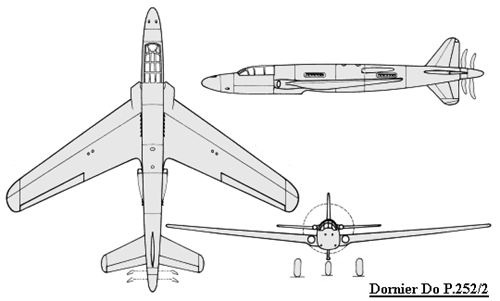
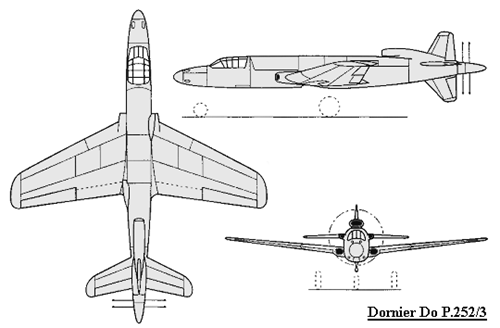
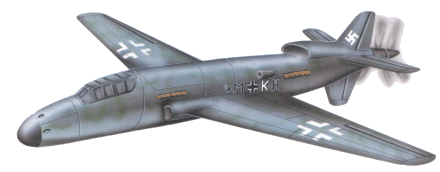
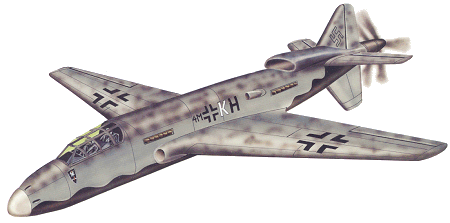
The P.252/3 had a lengthy fuselage, with room for a three man crew. The wings were swept back at 22.5 degrees and featured dihedral. There were two Junkers Jumo 213J liquid-cooled 12 cylinder engines (1750 horsepower for takeoff each) with MW 50 boost, which were tandem coupled to an extension shat that drove two 3.2 meter (10' 6") contra-rotating three bladed propellers that featured a blade sweep of 50 degrees. The front engine was fed by round air intakes located in the wing roots and on the starboard side of the fuselage, the rear engine was fed by an air intake located on the port side of the fuselage; there was also a large air intake on top of the rear fuselage just forward of the cruciform tail unit. One advantage of this tail design was that the bottom fin also served as a tail bumper to keep the propellers from hitting the ground on takeoff. The landing gear was of a tricycle configuration, with the main gear retracting inwards into the fuselage and the nose gear retracting to the rear. A three man crew sat in the cockpit located in the forward fuselage, with the pilot and radar operator sitting back-to-back on the left, while the navigator sat facing the front and to the right of the pilot and radar operator. The P.252 had a formidable armament (please see the table below), and there was an internal radar dish inside the interchangeable nose section.
Although there were definite advantages to this design, such as excellent visibility (due to the fact that the engines and propellers were in the rear), heavy armament and good endurance (approximately four hours), the official specification was only for aircraft to be powered by turbojets. So, the Do P.252 design was abandoned reluctantly.
| Span | Length | Height | Wing Area |
Empty Equipped Weight |
Loaded Weight* |
Max. Wing Loading |
Max. Speed |
Rate of Climb |
Ceiling |
| 15.8 m 51' 9.5" |
17.2 m 56' 4.8" |
5.05 m 16' 6" |
50 m² 538 ft² |
8600 kg 18959 lbs |
12300 kg 27116 lbs |
246 kg/m² 50.4 lbs/ft² |
930 km/h 577 mph |
21 m/sec 69 ft/sec |
12500 m 41000' |
| Equipment | Description | Weight |
| FuG 244/245 "Bremenanlage" |
Airborne Search Radar concave mirror antenna Range: 200 m - 50 km (656 ft - 31 miles) |
150 kg (331 lbs) |
| FuG 25a | Ground-to-air Identification friend or foe (IFF) |
12 kg (26 lbs) |
| FuG 280 | Airborne Search Radar infra-red homing Range: 4 km (2.49 miles) |
15 kg (33 lbs) |
| FuG 350 | Airborne Search Radar passive receiver for enemy radar Range: 50 km (30 miles) |
24 kg (53 lbs) |
| FuG 218R | 46 kg (101 lbs) |
|
| FuG 24SE w/ZVG 24 |
Ground/Air Radio homing device |
18 kg (40 lbs) |
| Fu Bl 3 E w/AWG 1 |
Bad Weather Landing Aid blind landing radio equipment |
10 kg (22 lbs) |
| FuG 101 | Bad Weather Landing Aid precision altimeter |
16 kg (35 lbs) |
| No. | Type | Location |
| 2 | MK 108 30mm cannon | nose |
| 2 | MK 213C 30mm cannon | lower forward fuselage |
| 2 | MK 108 30mm cannon | upward firing aft of cockpit |
| 2 | 250 kg bombs | carried externally below wings |
| 2 | 500 kg bombs | carried externally below wings |
While not the best quality, the following two images show some of the internal components of the Dornier P.252
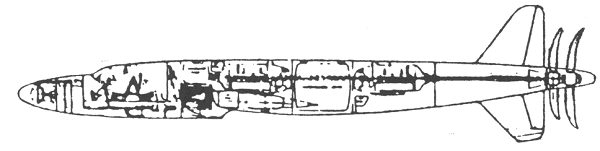 click to get a bit better picture.
Dornier Do P.252/2-01
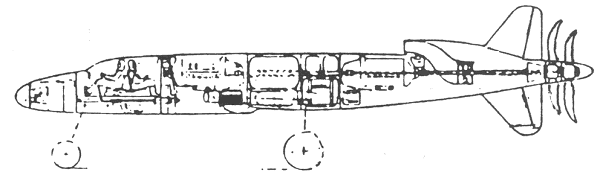 click to get a bit better picture.
Dornier Do P.252/3-01
Dornier Do P.252/1
16.4 m (53' 9") wingspan - Max speed 900 km/h (559 mph)
two man crew
(top and bottom images)
Above color images from:
Geheimprojekte der Luftwaffe: Jagdflugzeuge (top) & Luftwaffe Secret Projects: Fighters (bottom)