DON'T FORGET THE HORTEN SECTIONS MENTIONED IN RIGHT CORNER. ->
The 11th mars 2000 I got a unique opportunity. I was invited by Michel Mangenot of Air Est Services, the manufacturer of the Pelican, a remarkable flying wing. The design was by Jean-Claude Debreyer.
Whenever you see this Pelican you will say: "Man, it is small !". I did too.
Specifications JCD-03 "Pelican"
- Span 7,2 m 23 ft 7 1/2 in
- Length 3,1 m 10 ft 2 in
- Wingarea 12 m2 129.2 sq ft
- airfoil Abrial 17% (known in many of the Fauvel flying wings, been named "Fauvel 17%" by many). Here are the data of that airfoil.
- Weight 9 HP 80-85 kg 176 -187 lb 12 HP 100 kg 220 lb
- Engine, different engines possible:
- A tailmounted 9 HP or 12 HP A central mounted 30 HP (still in development) Landing gear
- A central placed single wheel, a tailwheel and a small wheel under each wing attached to a rod.
- Security coefficient to rupture +6 g
- Construction time 400 hours
- Performance with SOLO 12 HP
- Take-off run 150 m 492 ft
- Climb rate 2 m/s 6 ft 7 in/s
- Cruise speed 75 km/h 46,6 mph
- Take-off speed 40 km/h 24,8 mph
- Fuel consumption 3,5 l/h at 75 km/h 0.924 US gallons at 46,6 mph
- Autonomy 3 hours
I got this info from the firm that tried to sell the Pelican Kit, Air Est Services.
Origin of the Pelican, the JCD-02
Jean-Claude Debreyer read a article by M. Colomban about low power flight. It was one of the tools while he worked on his idea to create a low cost airplane. Something that uses a small engine (less than 10 HP) and that has a low fuel consumption and still have a good climb rate. Low power was mostly solved by using glider wings in that time. But glider wings are heavy. You need extra power to climb. A glider does not need that extra power as it is being towed in the air. But for a motorized ultralight, weight is very very important. Jean-Claude choose to reduce weight to the max to get his good climb rate.
He came to the idea of a small flying wing. His first guess was a wing area of 12 m2 with a airfoil of 17% thickness instead of the usual 12%. The articles calculations did lead to a aspect ratio of 4 and resulted in a span of only 7,3 m. He made his prototype in wood. It became the JCD-02 "Pelican".
Click the picture above to see more details about the JCD-02
3view of the wooden JCD-02 Pelican. Note the very short wingtip protectors. Later more about those.
Specification of the JCD-02
Wing area 12 m2
Span 7,3m
Chord root 2m
Airfoil Abrial 17%
Length 3,10m
Empty weight 60kg
Max take off weight 155kg
Engine Peugeot 125cc
Diameter prop 0,69m
It flew well, but it was a bit fragile. Not rigid enough. So came the idea to create a glassfibre, more rigid, new edition.
The glassfibre new edition, the JCD-03
After flying the JCD-02 Jean Claude wanted to correct a few issues.
The construction of the JCD-02 was too fragile. And he wanted to use a larger engine. So he started a heavier glassfibre construction and placed the spar 5 cm more forward in the wing. He wanted the pilot a bit more forwards to be able to use a engine that was a bit heavier (9kg instead of the 7kg).
3view of the JCD-03 "Pelican". Here the side wheels are much more lower than the wingtip protectors in JCD-02. Later I tell you why. Another thing i see is that the moving part of the rudder has a bit a different shape. Hinge line is the same, but the part in front of the hinge line is a bit smaller in reality.
Some will say that it looks like a Fauvel AV-36. Indeed it does. But all flying planks with two rudders would look about the same. The AV-36 is intended to soar. It needs a good glide ratio. Long, heavy wings. But as you know. Long wings lead to weight and Jean-Claude wanted to reduce weight for his goal of climb rate. So ... looks like a AV-36, but with shorter wings.
The JCD-03 made a lot of flights. It proved to be a very good sunday pilot airplane. Very forgiving. Jean_claude wrote me: "The airplane was very easy to pilot by no matter who, who had 20 heures of basic flight training."
If you doubted the twin rudders, Jean-Claude wrote: "The rudders were very responsive. Even at low speeds. They had a different deflection. The rudder inside the turn went to 15° deflection while the outside rudder did 9° deflection. On the ground the steering was done by the rear wheel which was connected to the rudder steering.
On the ground the only problem i had in the beginning was that the wingtip protectors were too short. The airplane was hard to control on ground due to crosswinds pushing under the wing." He also advised to set the contact point on the ground together with the main wheel. If the point of contact is too far backwards it gives problems with crosswinds.
Peu=mieux translates to "less is better"
Contact de sol -> Contact with ground
Bon -> Good
Mauvais -> Bad
JC Debreyer wrote me that the minor problem about pitch steering was the fact that the elevators were in a disturbed air stream from the fuselage and prop. That gave some vibrations in the control stick.
Mr. Mangenot proposed to try to get the center piece to 2m for easier transport with detachable wings. JC Debreyer proposed if he would do that he needed to create elevons instead of seperate elevators and ailerons.
Other advantages would be: 2 instead of 4 control surfaces to make and no more vibrations in the stick. Sadly Mr. Mangenot did not know how to make the needed mixer. That mixer is really easy to make. Go see the Horten pages to understand. Go see the details about the Horten HXb.
At the time of our surface mail contact, i was thinking about a selflaunching glider in small shape. Jean-Claude wrote "It is not because a airplane can fly on minimum power that is is good for soaring. Pelican has a glider ratio of 10-12, vertical speed of 2m/s." I realise it is not much, but ...maybe ...a good beginner primary glider. The popular GOAT modern primary glider of Mike Sandlin has a glider ratio of 10. I guess a Pelican glider might be easier to build than the Goat. Less parts. Smaller in size too. Less heavy? Goat is 64 kg.
Hmm ... my creative mind is tinkering again. Pelican keeps being an inspiration. Thanks, Jean-Claude.
Jean-Claude mentioned he made a mistake in the wing design. He placed the spar 5 cm more to the front in the wing. But he did not replace the missing leading edge skin in that 5cm area. So the fabric started sinking in between the ribs too early. He wrote that it probably cost him a bit of the performance.
Something that become clear when seeing the Pelican design is that the main parts are widely spread. Pilot and engine are far away from each other. It seemed that Jean-Claude once said that the Pelican was a ONE PILOT / ONE ENGINE design. Not really suited for a large range of pilot weight. Be sure to ALWAYS check the CG when flying a Pelican inspired design. This mistake did damage the restored Horten HIb glider. It was test flown and it flew good. Somebody else with a different weight wanted to make also a flight, CG was different. Glider flew very poorly due to bad CG and it made a very hard landing, damaging the lower front of the glider. So ...keep a eye on CG!
Short report of my visit to Air Est Services
During my talk with Michel Mangenot I asked him if you needed to be a experienced pilot to fly the Pelican. "On the contrary", he said, "it is a ideal plane for a beginner with limited resources (= money). It is cheap and stable enough for a beginner." When he said cheap I had no problem to believe. The next picture shows one of the rudders and the elevator in construction. Do you see the blue foam?

On the background you see the bottom of a project (black rain drop shaped plate), which Michel Mangenot did help. It is a part of a car that did "race" in a competition where cars have to ride as far as possible with ONE liter (0.26 US gallon) fuel. This team of students made a good race. Mangenot did advise them in the use of composites and did help to construct the cars body.
Did you recognize the foam? Yes, it is the blue isolation foam you can buy in any local DIY. The low wing loading allows the use of this foam in the construction of ribs of the wings and rudders.
Sadly not visible in the picture is the spar of the wing. It was a honeycomb plate! Might have been a more expensive part of the kit. I have no clue how you cut honeycomb plate to a needed shape. Anybody can explain it to me?

Just to show the small dimensions of the Pelican.
On the background there are several secondhand gliders and ultralights for sale. Mangenot travels the world in search of these secondhand. (picture by me)
Michel Mangenot was working on a Pelican with detachable wings. But I started thinking: "Are detachable wings necessary?" All the classic sport planes like Piper, Cessna, Robin don't have detachable wings. They are delivered to your airstrip and then you stock them in your hangar. Why wouldn't you buy a Pelican if you have a hangar (your own or the clubs) to place it in on your local airstrip. One-piece airplanes are easier to build, are lighter (no heavy connection points) and you don't have the fuss with connecting cables or rods. The problem of getting it to your airstrip is only a one-time-event. I am sure that moving companies can be a easy solution for this event.

Here you see the blue foam again. Also visible is the 17% thickness of the airfoil. (picture by me)

This is how it would look like when finished. The JCD-03 getting ready to a flight.
Fate of the Pelican JCD-03
Status 2026: Sadly Mr. Mangenot passed away. The kit i saw was never sold. No idea where the part of the kit are now. Mr. Mangenot made plans of a wooden edition of the Pelican, named the Vampyr. I knew about one construction in progress but it never got further than the fuselage. Never heard about any process after that.
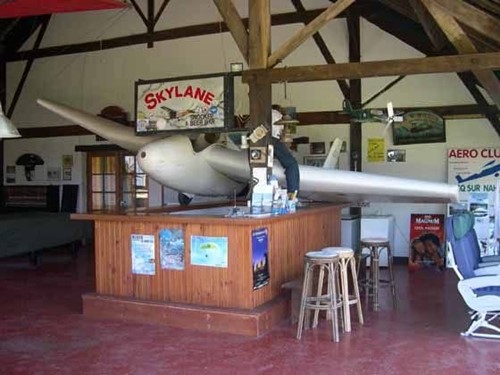
I was happy to get a picture of the one and only Pelican current location. A barn of a local airstrip in Vick à Nahon in France. (picture by Yves Elias).
Sadly nothing is known about the fate of the moulds of the Pelican.