
I recall to have read that it makes steering a WIG less tricky. I recall that it has something to do with the shift of point of pressure under the wing which changes according to the height. If you can guide me towards some text which explains it again to me, please do. I want to understand this design again.
The designs of Lippisch were probably forerunners of the larger Airfish 8 (it also is known as Flightship 8). Lippisch started his WIG research in the 1960's. His X-112 was mentioned in the Jane's of 1964-1965.
The Lippisch X-114, a larger edition of the X-112, was damaged beyond repair after a crash. Reason of crash was a test with using hydrofoils to get the hulls quickly out of the water. You can read more about this on the common mistakes page.
Airfish 2


Airfish 3

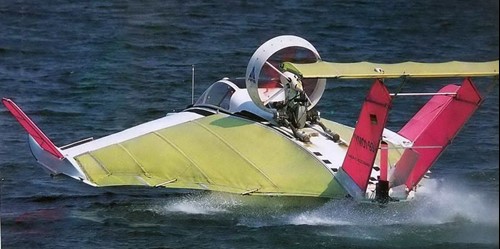
Airfish 8
National Geographic episode about the Airfish 8
Lippisch reverse delta for WIG / How does it work (i try to understand)
This design really puzzles me. In some articles in the past it was mentioned as being a solution for the common steering problems in the Ekranoplans. But if i look at the design as a non-engineer with some basic understanding of airplane design, i see things that would say the opposite.
I know that the pressure point shift between ground effect "flying" and real flying (above the ground effect area). In normal flight it is about at 25% of the mean chord of the wing. In ground effect that pressure point slides backwards to about 50%. It is the task of the elevator to keep the airplane pitch moment stable enough so the nose does not dive into the water or goes sky high. That is easy to understand. But ... if you create a wing with a lot of taper, you make that the mean chord slides more towards the center of the airplane. The mean chord gets longer as it is closer to the longer root chord. So ... the distance between 25 and 50% gets longer too. So the effort needed to keep the WIG stable is larger than in a straight wing WIG.
How does the reverse delta create stability?
The reverse delta and the negative dihedral, which is typical for the Lippisch reverse delta) creates a kind of cup shape under the wing. I do understand that it might create a quicker high pressure under the wing. That would result in a quicker take off out of the water. Getting quickly out of the water is a good point for WIGs. It makes less drag. The speeds can rise quicker. That is easy to understand.
But ... the increased stability still puzzles me. How does it work? If you can guide me towards texts that explain it, i would appriciate it.
On the homebuiltairplanes.com -forum i found this answer of a member named Jedi: "In ground effect the loss of lift due to tip losses is reduced therefore the CP (center of pressure or effective center of lift) moves outboard and forward with the reverse delta when in ground effect. This counters the CP shift from the transition of the CP from 50% to 25% MAC as the aircraft climbs out of ground effect.
This characteristic is amplified with the anhedrial and tip plate effect of the floats in the Lipish configuration."
This characteristic is amplified with the anhedrial and tip plate effect of the floats in the Lipish configuration."
And it makes sense. If the CP moves outboard, it gets to the shorter chords. And there the distance between both pressure points conditions gets shorter. So ... less trouble to counter that CP shift by using the elevator.
But i do think there is more to it to explain the better stability of the reverse delta.