Changing it into a 3 axis steering
I added this modification in the page of the WING modifications.
The steering system with steering wheel instead of steering stick
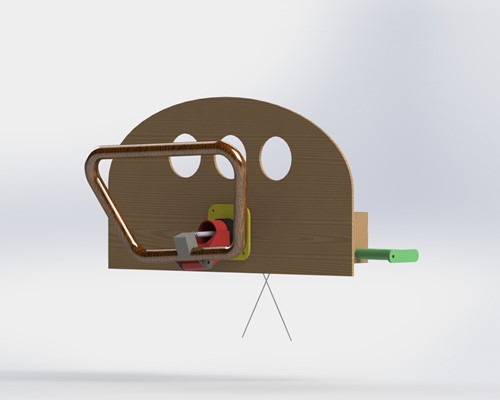
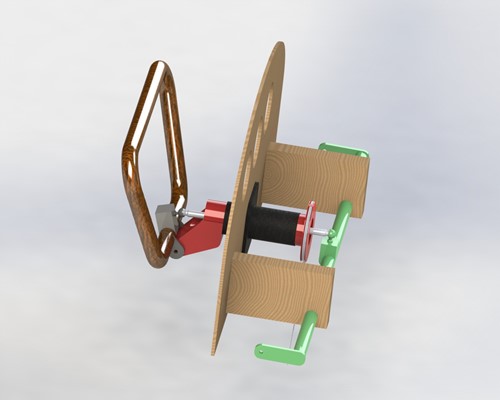
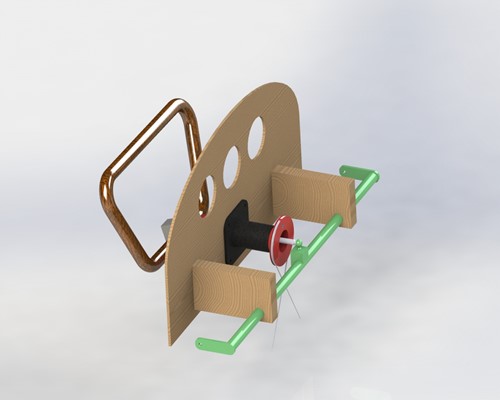
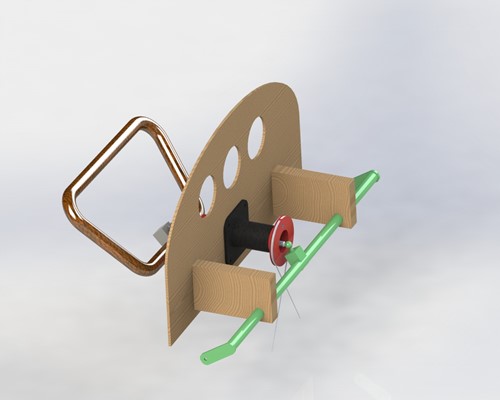
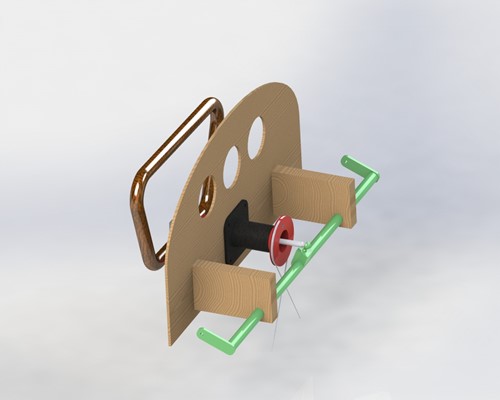
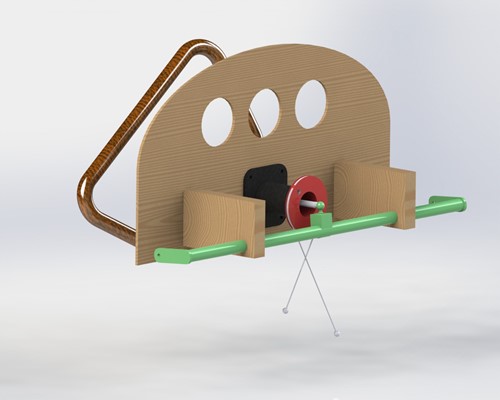
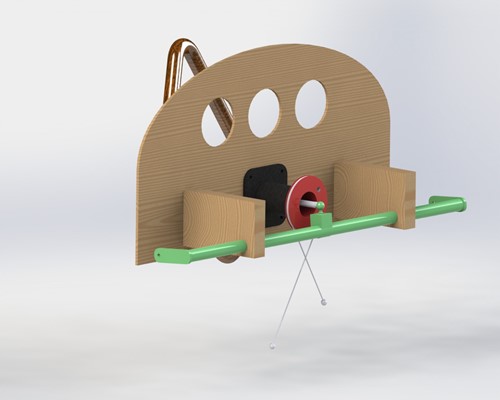
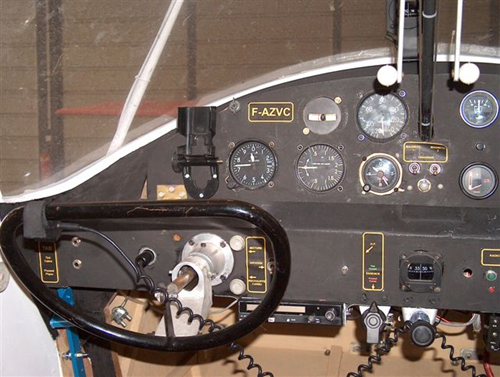
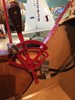
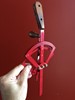
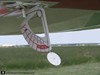
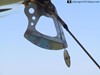
The steering system with steering wheel instead of steering stick
The Landray GL1, a Flying Flea designed by Gilbert Labdray, has not a steering stick, but a steering wheel. And recently i saw how it works. Super easy. I hope my 3D's will explain how it works.
Yellow part: holder of the hollow tube that serves as a axle.
Black part: hollow tube with a holder at the other side of the panel. Bolts connecting both holders keep the hollow tube in its place.
The steering wheel: it has a rotation point at the bottom. It also has a connection point for the pushrod that goes through the hollow tube.
Red part #1: it is fixed onto the control tube that runs throught the hollow tube. The control tube touches the inside of the hollow tube. So it functions as a axle. The red part is fixed on this side of the panel. It has a rotation point at the bottom. The steering wheel is installed there.
Red part #2: it is a pulley in which runs a cable. It is installed on the same tube as the other red part, but on the other side of the panel. This red part is installed that way so there is no play that can make the control tube slide back or forth. The cable that runs in this pulley is fixed at the top of the pulley.
Green part: it is the angle of attack control bar. It rotates. The levers at the end are connected to the rear spar of the front wing. How much the control bar rotates is done by the pushrod that goes through the hollow tube.
Pushrod: it connects steering wheel and angle of attack control bar.
NOTE: i drew the cables at a certain angle and made them end with balls just to make them more visible in the function pictures. Originally those cables run horizontal normally. They follow a pulley and change direction to the rear. That pulley should be drawn just next to the levers of the angle of attack control bar. But ...that would be rather difficult to show how the cables work. So ...i drew the cables at an angle downwards. I hope you all forgive me this "poetic freedom".
Now you saw the parts. Below you see how it works.
Pitch control
That hollow axle has the pushrod going through it. That pushrod connects the angle of attack control tube (green part) to the steering wheel. If the steering wheel goes forwards, the control tube rotates so the levers at the sides go upwards.
Rudder control
The hole in the pulley is just to make it visible that the wheel rotates.
If you rotate the steering wheel left or right, the pulley at the other side of the black tube rotates too. The cable, that runs over it, is fixed at the top of the pulley. It makes the cable go left or right according to the rotate direction of the steering wheel.
Turn the steering wheel right, the pulley turns right too. The cable, that goes out the fuselage at the right, gets shorter. That cable pulls on the rudder so it rotates counterclockwise when seen from above.
Single or two seater
Both can be equiped with this system. In two seater, you can use the same angle to attack control tube and you connect the pulleys with each other with that cable. The pilots pulley (left seat) has cable going left and it is connected by pulleys to the rudder. The right wire of that pilots pulley is going to the pulley of the passenger. There it rolls over the pulley and gets out on the right and goes with pulleys to the rudder.
Advantage of this system
I start to think that this system makes the controls less difficult in sensitivity. The flight stick is known for being really sensitive. Old pilots said that the amount of movement of the stick in a Mignet Flying Flea in normal flight is about the size of a large coin. Very sensitive. I think that we are using to steer our car on the highway with the same amount of movement. So i guess the steering wheel is easier to steer if the system is so sensitive as they say.
Can anybody who steered a Flying Flea with a steering wheel confirm of correct me?
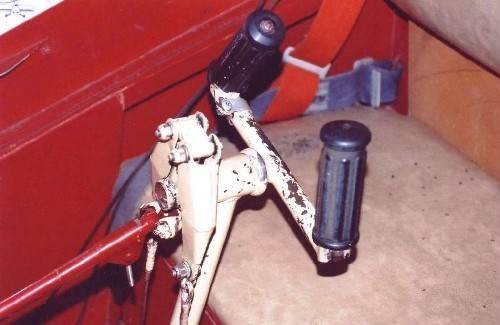
Here is a variant to this idea which was installed in the large Croses BEC-9 Paras-Cargo.
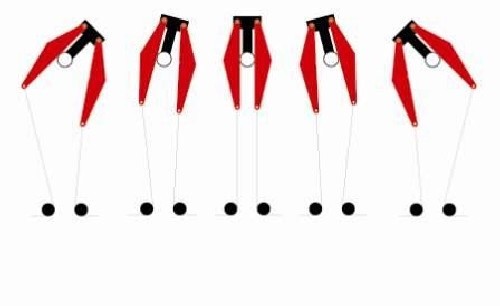
Progressive steering by Frank Easton
Frank Easton made this steering system which is less sensitive in the middle. So it steers less nervous. The team behind Pouguide.org made a special page about this progressive steering system. Sorry, it is in French. But i hope that the pictures here already give good info to test it yourself.
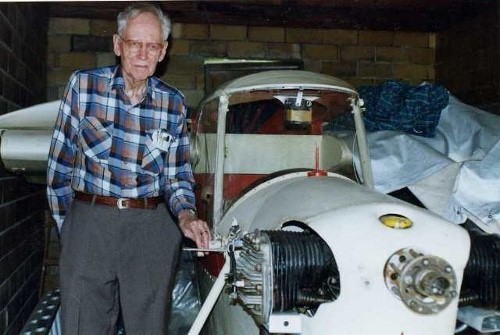
Below is Frank Easton beside his HM20 with that clever steering system.
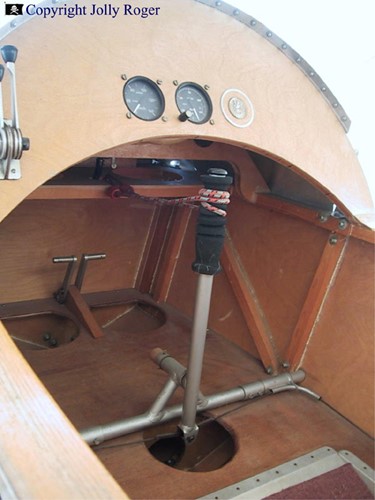
Pedals
I am not sure if they are here being used for braking left and right wheel or if the controls are made classic (stick= pitch and roll, pedals= yaw). But i guess it is for braking. The stick has cables running to the back. I guess towards the rudder.
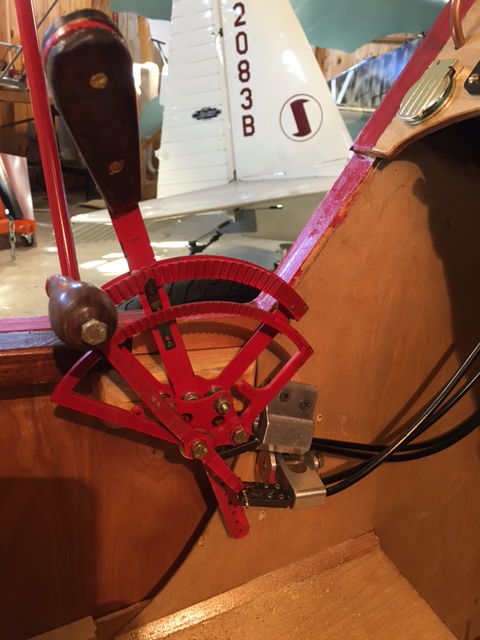
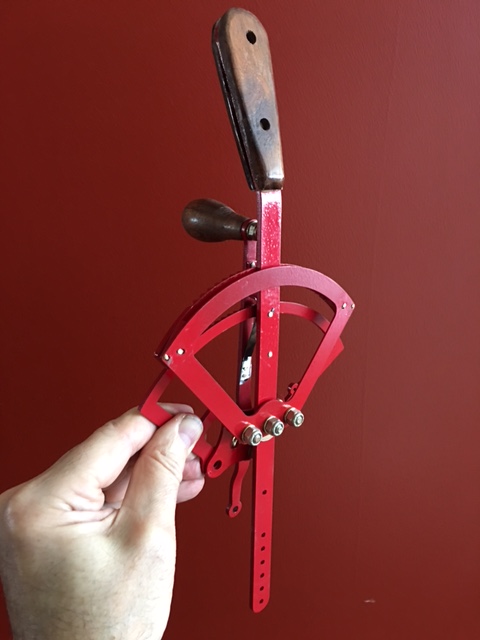
HM14/JIM BRUTON/Throttle control
Not sure if he made it or bought it. But hey ... this thing is ultra retro.
All HM's / very simple speed gauge
No words needed.