Don't change airfoil, span, chord, rotation point or gaps between wings without knowing what you do. I only changed the airfoil of the OpenPou glider, i was building, towards another proven airfoil in Flying Flea designs. This Living Wing concept is not as changeable as a cantilever wing on a "normal" airplane.
Ok, now the stuff i found on existing wings.
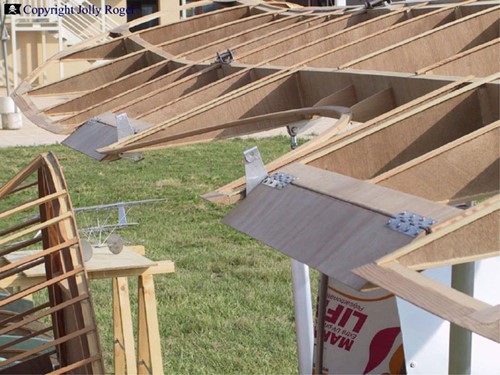
HM163 / trims on front wing / Hans Engels
Hans Engels is in my point of view a genius engineer. If i would consider trims on the front wing, i would use something like this. If i recall it right, he said to me the trims could be adjusted by hand at the place of the trims. Correct me if i recall wrong. Picture from Jolly Roger website (Jerome Falc).
Making a three-axis Flying Flea / Juan Jose Garcia Buergo
I don't want to make a big noise about this, because the Flying Flea does not really need it. But several people will only consider the Flying Flea is it was a three axis airplane with conventional controls. So, stick controls pitch and roll and pedals control rudder. It is been proven that it is possible. This is the way Juan did it.
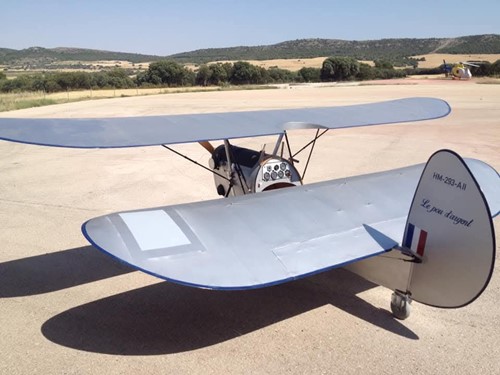
The original flap in the rear wing is visible. Here it was still a one piece flap. Juan made a split flap version. See below.
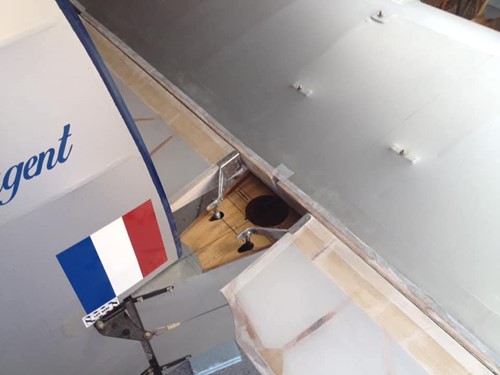
Here are the levers visible that control the flaps/ailerons (lets call them flaperons from now on). The rods that steers them go inside the fuselage. There is the mixer that mixes the stick control that fixes the roll of the airplane and the lever of the flaps that control the descent rate. Remember ...IT IS A FLAP, NOT A ELEVATOR. The front wing is still the elevator.
The mixer of Juan is a very clever one. Very simple. And it proved itself already.
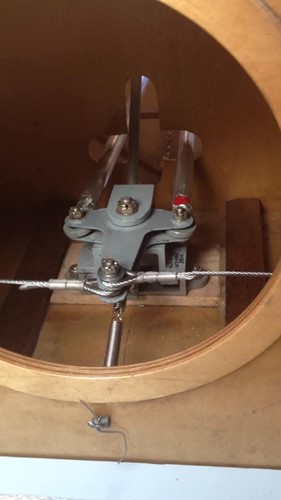

This video shows how it works. Looks rather easy.
Juan said that he could land his adjusted HM293 with these controls in a crosswind of 10-12 knots (grass runway).
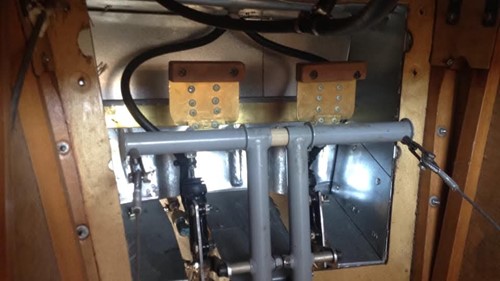
Here are his pedals for rudder control. I think to see he also has tip toe brake controls.
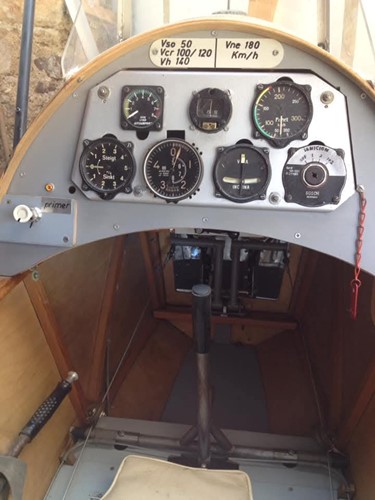
Here is the lay-out of his cockpit. Flaps control at the left.
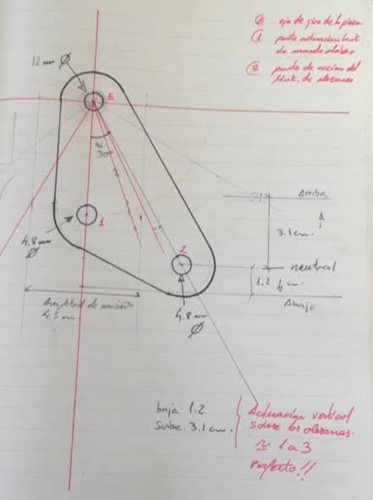
This lever, that Juan made, make that the upwards and downwards deflection of the ailerons is not the same. Both go similarly up and down as flaps.
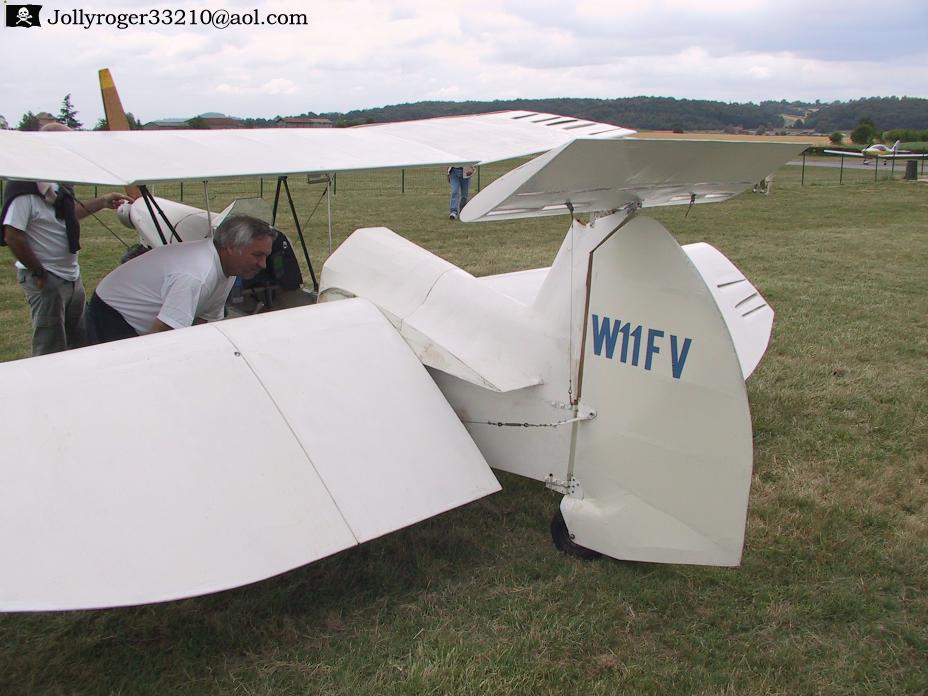
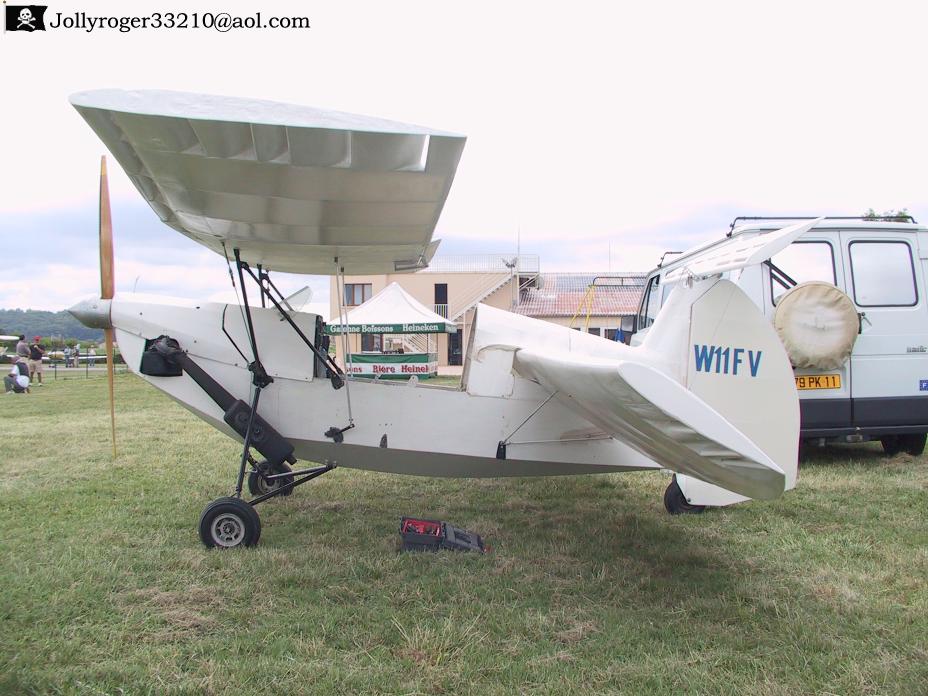
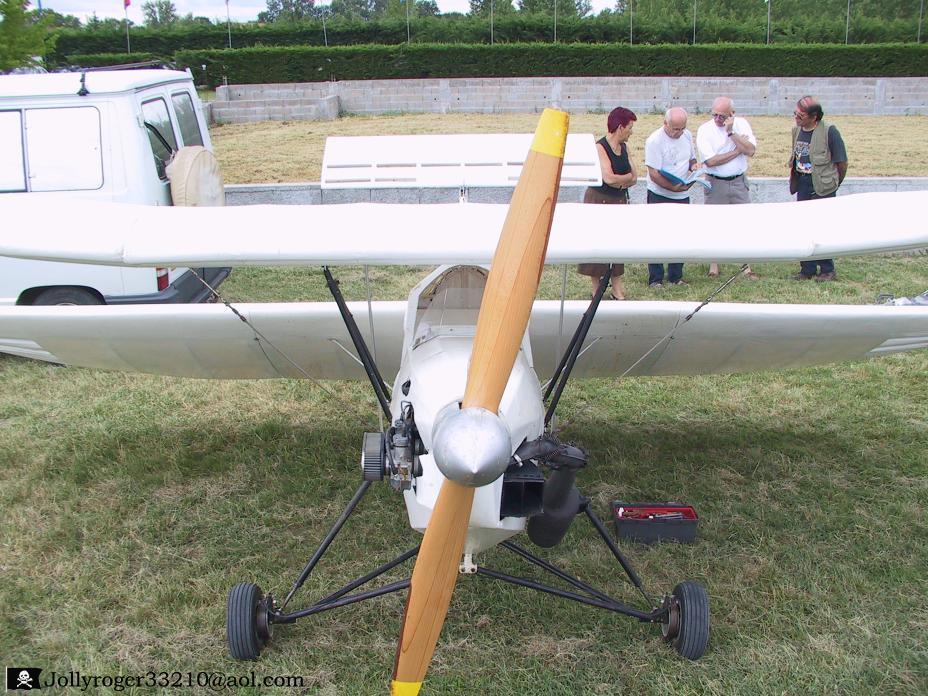
MILVIUS / concept similar to Pulga of Jean De La Farge / Lucien Ricard (France)
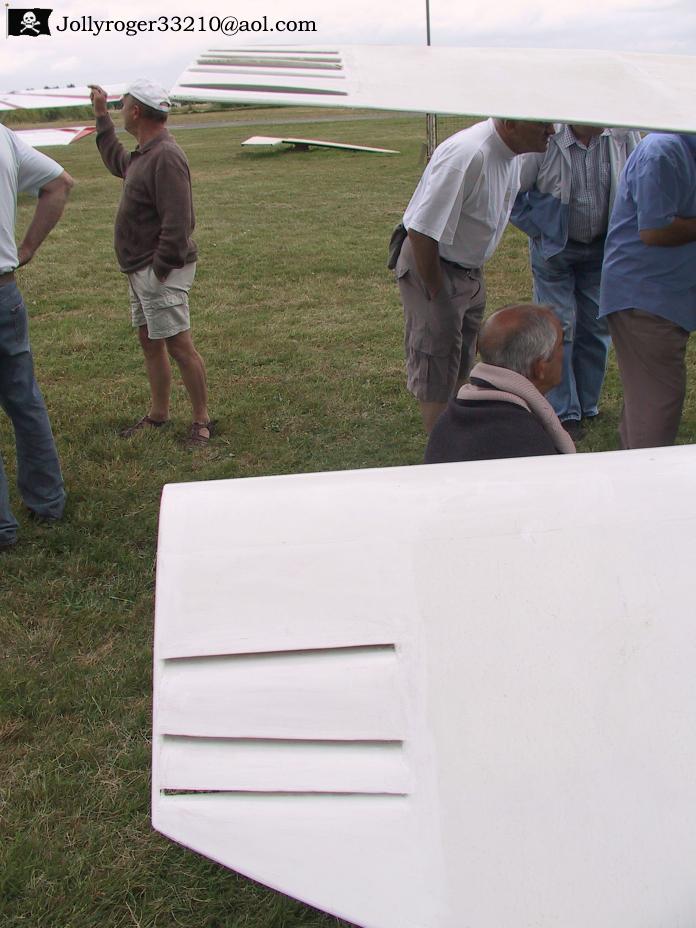
I missed the meeting when this one came to show its very rare features. The front wing has multiple small wings, just like the Winggrid concept, which was used to increase efficienty of low aspect ratio by reducing the vortexes at the wingtips. Beside that it has a rotating rear wing. Not rotating like Herni Mignet proposed in his book of 1936. Mignets rotating rear wing rotated counterclockwise if you look at the airplane sideways with the nose to your left. This construction here has it rotating clockwise. Also note that the rotation point of Mignet was at the underside of the front spar. Here it looks like the rotation point is the attachment point of the struts at the lower side of the fuselage. So the wing rotates and slides backwards. A third feature we are not used to see it that "elevator" at the rear. Actually ... it is NOT the elevator, as that one is located at the front in a Flying Flea design. It has the entire front wing as a elevator. Here i would call it a third wing.
My first thoughts were: "those test flights will be interesting!" "It is like a De La Farge design, but that rearwards moving rear wing is a bit difference"
Ok, this one it really inspired by the work of Jean De La Farge, a man in Argentina, who made similar three winged Flying Fleas. He called them Pulga. They were able to take off and land on very short strips. But they were a bit complex. I came in contact with Juan Galvan and his son Martin, who have a newly made design similar to the work of Jean De La Farge, but a bit simplified as it has not the rotating rear wing and the third wing is also not rotating. I was really impressed by this design. More info will follow once i understand more how it works.
Returning to this design in France. I have only seen these pictures of this construction. Little is know about it after this meeting. If you have more info about it, please, tell me.
Advise to all who want to test new concepts in Flying Flea style:
- realise that the Flying Flea behave different. So adding something more might end up in even more different behavior. Be careful!
- test your concept with hundreds of ground runs and hundreds of crow hops.
- make sure to install some parachute to get airplane and pilot safe down in case of trouble.
- don't do tests because the people around you are curious. Do it all on your own pace. Sadly we lost a over-enthousiast builder that way in the meeting of Montpezat in 2005. Don't start to fly a flying flea by taking off. Even if you are a experienced pilot. ESPECIALLY if you are a experienced pilot! A Flying Flea react not like a normal airplane. Don't count on your experience with "normal" airplanes!!!!
Pictures from Jolly Roger website (Jerome Falc).